Showing posts with label male burlesque. Show all posts

Thursday, December 22, 2016

Mindless Praise vs. Effective Critique

As many performers I know can attest to, it's very easy to get praise for your work from fans, peers, and other performers. It's almost impossible, however, to find good, constructive critique that pushes you to be better.

After watching myself in the role of Barry Dylan from the burlesque adaptation of the television show "Archer," I felt thoroughly pleased with myself and the performance I gave. I mention this specifically because I rarely feel this way about my performances. Even though I felt satisfied with how it went, I still wouldn't have minded if someone had made some suggestions on what could have used more polish.

"I said GOOD feedback, you dullard!"


The best performers I know place a high value on effective critique, and I've come to find that there isn't all that much of it in burlesque. In general, I've found that it's very easy to surround yourself with people who have nothing but adoration for you, and I absolutely believe that there's nothing worse than that if you're trying to grow as an artist. It's hard to fight that instinct.

As far as the duo act I did in that same show, I felt a lot differently. In that act, Danny Drake (as Archer) and I did a duo-acrobatics striptease that resembled a high-energy fight scene, a confrontation where we illustrated the futility of these two characters' persistent quarrel throughout the show. I discussed with Danny a lot of personal critiques I came up with about how the performance went, and would have loved to have heard more from other performers about what worked and what didn't while we were still in the rehearsal phases. In my opinion, the act looked a bit contrived and juvenile on video, despite me being smashed in the head at one point with a glass bottle.

Yes. It did really happen.

It got me thinking quite a lot about the reasons our performances sometimes don't look polished in the ways we want them to. Why do we create our performance pieces in isolation while avoiding checking in with people we trust along the way?

I was reading Mary Cyn's blog about how to take and give effective critique, and it inspired me to want to finish this post that I've kept shelved for a long time. One of the big reasons that I wanted to hold off on finishing this topic is that I knew I hated some parts of burlesque performance because of how the community at large handles effective critique, but wasn't sure how to get it into writing. Mary helped me to figure that out with her own take.

The title of this entry, phrased as "Mindless Praise vs. Effective Critique," doesn't quite encapsulate the entirety of the issue. If I'm honest, I would tell you that me giving crappy critique and shaded criticisms also factors into my motivation for writing this, though that seems like too many words for a blog title, expressly for the point of washing my hands of things my younger self once did. One of the reasons I like to teach other guys how to do burlesque is because it gives me the opportunity to help develop and course-correct in a forum where constant feedback is the expectation, and to further reinforce those lessons in writing after their first performance. Plus, I get to deliver feedback in a way that I would have wanted to receive it.

"I dunno man. Your words seem a little harsh."


As artists, we have a tendency to believe that the first thing we think of (and indeed EVERY thing we think of) is the best idea anyone's ever had. I've certainly come up with some crap ideas (see; The Worst Burlesque Act I've Ever Done), and some were more obviously crap than others--but the finer point is that it took some hard coaching to get me to the point where I accepted that the aforementioned act was a garbage fire, and I don't know that I would have accepted that conclusion on my own.

The ways we experience rejection in burlesque isn't the same way rejection is doled out in other walks of life. It's fairly straightforward when a hiring manager tells you "you didn't get the job," or when a love interest tells you that she's "not all that into you," but I've found that most of the discord between response and critique in burlesque focuses largely on whether or not you're attractive on stage, and not necessarily on whether or not you executed great choreography or told a truly compelling story. Our audiences and fellow performers frequently tend to focus on whether or not we're "hot" up there, which, if you're a stickler for the technical stuff, can seem extra superficial. So rejection can look like straight up silence, unless you do something aggressively inappropriate.

But we all occasionally tell each other that our performances are "sexy" and "mega-hot," and most of the time that's totally okay to do.


"Please tell me I'm beautiful."


As performers, I think we owe it to ourselves to help each other out with specifics. What I like to do is to pick two or three things that I can say to someone when they leave stage that I loved about their performance;

  • "Hey, I love that your fan dance was just two giant mustaches, it was super clever!" 
  • "That cartwheel into a split right when the theremin solo started was so well-timed!"
  • "Tearing your sleeves off to reveal two tinier, angrier sleeves was choice!"

Alternatively, there are some bits of feedback that are more critical. These are useful to give out (with permission, of course), if the person is looking for a bit more honesty about what didn't work well for you. Bear in mind that while I personally love hearing more corrective comments after a number, most people tend to feel that this works directly against their performance high, which can be a tad soul-shattering. So always make sure it's welcome to say things like these, paraphrased from actual critiques I've given;


  • "Your expression in the beginning was distressed and shameful, like you were a hostage--but I don't know if that was the consistent with the tone of the piece. Was that intentional?"
  • "Your costuming struck me as being racially insensitive. I might avoid using headdresses and kimonos when you do this piece in the future."
  • "I don't think using actual liquids and real knives in your piece was a good idea for safety reasons."
  • "There were one or two dance moves that seemed inconsistent with the mood and music, could you tell me about that part of the choreography?"


Reflexively, this is the kind of stuff I find most helpful. While we ultimately want to be the best performers we can be, the only way to improve is to hear specifically what didn't work, and to parlay those suggestions into conversations about what we can do better.

"This air BJ really worked for me!"

Which brings me to the last part. Often, I find that a shared instinct we have as artists is to explain away criticism. If I know that someone says they are receptive, I'll log my observation with them without ending in a question. Frequently with newer performers, I find that it prompts a (usually lengthy) explanation of why what I mentioned has to stay the same.

I'm not saying that there can't be a reason why something I disagree with should remain in a performance piece--but if it's something that you had to clarify at length to an experienced performer, it probably isn't something that's all that clear to your audience.

So in essence; watch and listen, ask permission to discuss, give thoughtful and meaningful critiques, encourage vigorously, and be receptive when others offer you feedback in return.

ART!

Friday, November 27, 2015

Performing for Largely Hetero Audiences

First of all, Happy Thanksgiving to all!

I wanted to write a bit about my experience with performing for crowds comprised mostly of straight men, as I've had a lot of unique and strong feels about it. Mostly excitement, but sometimes terror. I'd like to take you through that emotional process and where it all originates.

Women's burlesque performance is generally more well received for new audiences, due in large part to the socially-reinforced way women's sexuality is available for public consumption. Women are expected to be looked at and appreciated, regardless of the gender makeup of the audience. Both men and women will watch in adoration at female striptease, as it is acceptable to do so. I'm here to write about what happens when a male burlesque performer presents to a crowd of new, straight-ish people, because the reactions are often much, much different than the reactions that naturalized, familiar burlesque audiences display.

Such as leaning-accented casual indifference.

I was a bit on edge for a recent gig with Brandy Wine and Polly Surely of Rogue Burlesque, as it was the type of setting where burlesque didn't quite seem to fit the programming. As I alluded to in a previous post, this was a high-energy party where DJ's from around the country were gathering to drink and dance. We went down into the basement, which was its own party-hearty room, complete with dim lighting, beer spilled on the floor, poor sight lines, and every formality spared. I'd say it was an audience with an 80/20 man-to-woman ratio.

Needless to say, very few folks in the crowd were acquainted with burlesque. After our host for the night started explaining burlesque etiquette, you could absolutely hear the sarcastic chuckling. While I knew they were probably picturing a club-esque strip show, I doubted they were ready to factor me into their expectations. As I mentioned way back in the second paragraph, the onlookers were pretty amenable to seeing Brandy and Polly perform. When I stepped onto the floor though, there was an audible groan from many of the males in the room. I would estimate that about 1/3 of them immediately turned around and walked out.

In that moment, I saw a clear picture of what scares straight men about male burlesque. When I teach my class for new male burlesquers, I like to gradually introduce clothing reveals and let people opt out of ones they aren't (yet) comfortable with. To their credit, the guys in the class are usually willing to jump right in and do all of them, which is fantastic. I'm guessing that the mental re-configuring that happens when a group of men who have never met before begin to accept that they're about to be nearly naked in front of one other, they move past the head-space that my audience at this gig was stuck in. In essence, they were frightened.

Usually, the screaming is internal.

Since performers tend to draw energy from the audience they go on for, I can tell you that when this happens, it's often demoralizing. To that end, it manifests itself in a few different ways: In struggling to cope with the fact that they might have to watch another man strip, these men will usually show signs of physical discomfort--heads down, arms folded, groaning and audible commentary. James and the Giant Pasty of Boylesque T.O. (based in Canada) told me that at one show, a group of men in a bar lashed out and called him a faggot, which is the ultimate show of insecurity through aggression.

There was a point early on in my performance career where a reaction like this would have ruined me. Thankfully, I've had enough practice with the "show must go on" frame of mind that I'm usually able to compensate for situations like this. As a general rule, I focus my broader moves on the people who are having a great time, and I focus my specific audience work on the individuals who look the most uncomfortable.


Or in a pinch, anyone who is currently shrieking in terror. 

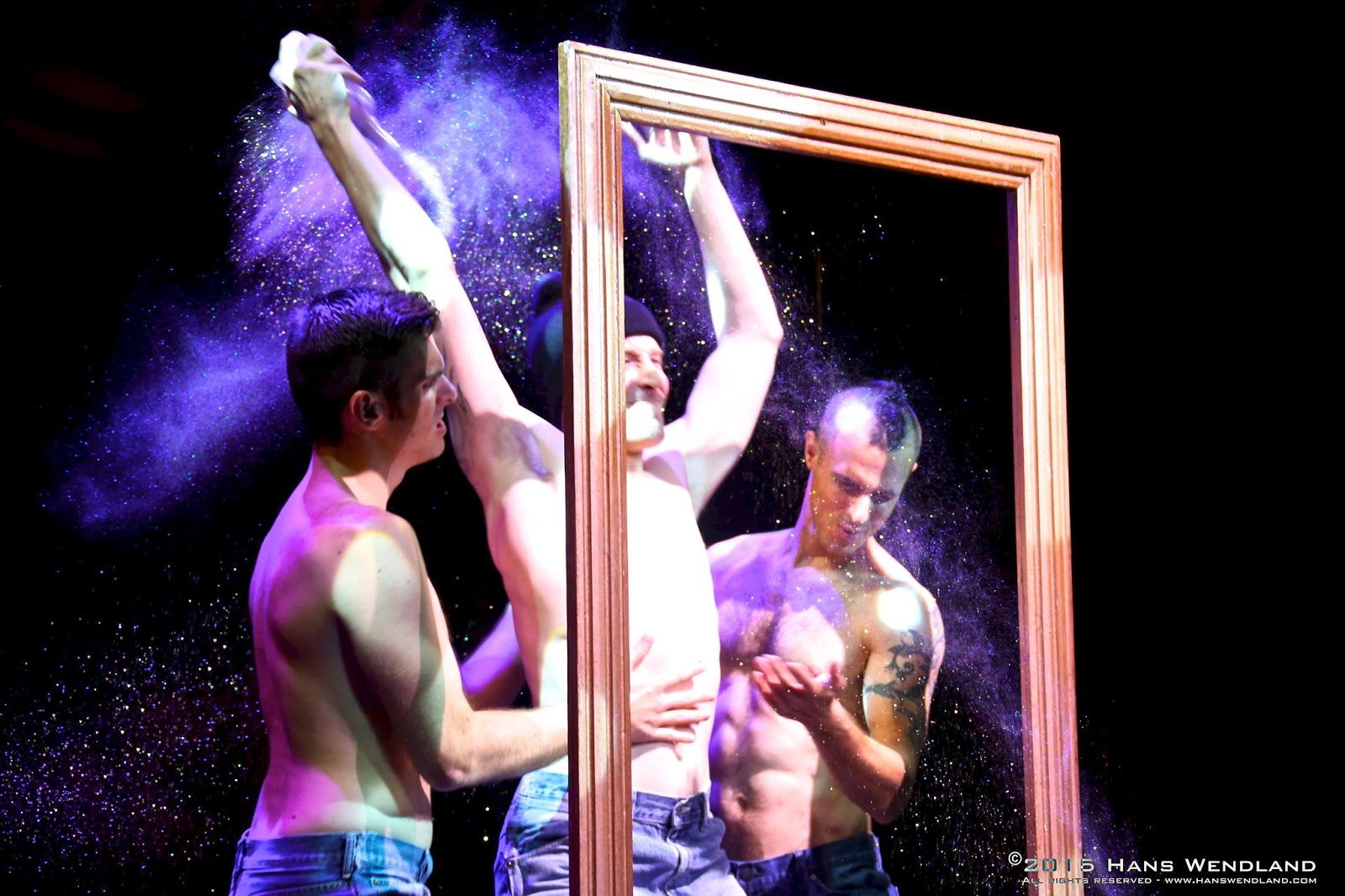
During my act, one man in the front of the audience buried his face in one hand in disbelief, as if one errant gaze upon my glittery pecs would turn him to stone (see what I did there?). I walked up to that one guy in the crowd, put my face about half a foot from his, waited for him to notice, and then gave a wave and a curtsy. He laughed just a little bit, and it got such a rise out of the crowd around him. I find that if you go for the hardest nut to crack, your success in getting the audience to join in the fun will have a ripple effect, and can often noticeably change the mood of the room.

Following from that, I'd like to talk to you about what happens after a performance like this. Due in large part to fragile masculinity (#masculinitysofragile if you're so inclined), straight men tend to conflate male burlesque performance with homosexuality or flirting. While it's not always a negative thing that some men will give feedback after watching a male burlesque performance, it can absolutely be derived from a place of awkwardness or insecurity. Picture any of these after a performance;

"I'm not gay, but....that was a good show/you were funny/I've thought about kissing a man/etc."
"Do you get a lot of gays/women/men hitting on you after you perform?"
"I saw more of you than I wanted to see, but you were pretty cool to watch."
"You were good, but you should work out more." (Lucky, thanks for sharing that last one)

"Look bro, I'm not gay or nuthin', but, uh....good
 job, there....dawg. Did I mention that I
 reeeeealy like the ladies?"

Some of you reading this will recognize these experiences as your own. But while icky on the surface, they can be a good starting point for having a strong, valuable discussion with a new fan about burlesque, body norms, and expectations around performers from the same/opposite sex.

I've learned that for every 20 dudes in an audience I perform for, one or two will come chat with me afterwards and will be completely awesome to talk with. After this gig, there were 3 guys that came to talk to Polly, Brandy, and myself, and wanted to reiterate that they had the best time at the show. While they were each initially confused about how to react, all of them individually had the wherewithal to figure out what they appreciated about the performance, what questions they wanted to ask, and the enthusiasm about discovering us and our scene afterwards. It was awesome.

For me, having just a couple people telling me what a great time they had makes it 1000% worth it. Bringing new people to future shows helps bring burlesque more and more into the mainstream, which benefits us all. I also love when other men feel inspired enough from burlesque to want to try performing themselves, as it's a major disruption to the power structures that influence masculine negativity (and bolsters our solidarity with our female counterparts).

And that's pretty rad.

Saturday, November 7, 2015

Get Those Dollars Out

Since I came into burlesque in the Boston, I'd noticed that there was a very distinct performance culture here. Boston burlesque performers tend to be more theatrical, tend to bring the strange into the mainstream, and are generally group-oriented in how they advertise. It wasn't until I started performing outside of Boston that I began to realize that we had a very interesting stance on tipping, which is hardly reflected elsewhere.

I had been performing about 3 1/2 years before I was a part of a show where the patrons were asked to tip the performers.

I was definitely a little confused when I'd first heard the host setting that expectation with the audience. I wasn't against it per se; I did have a rudimentary understanding that making any kind of money as a performer was and always would be a hustle. I had worked restaurant gigs since I was 16, so I full well understood how tipping worked. I just had never been party to a producer linking that to performance.

As an integrated part of burlesque performing, the concept makes perfect sense. If the performer really blows your socks off, you throw them a bit of extra money to show your appreciation. Ergo, your performance can have an influence on how well you do that night. That's capitalism, baby!

"I mean, I thought that's how we were supposed to fix the economy."

It reminded me of the one time I accompanied a friend of mine who was about to be married to a strip club. The biggest thing that stuck out to me about the way the strip club's economy worked was that every part of our visit was commodified. There was a cover charge when you entered, you were expected to have smaller bills to tip the dancers, buying drinks had its own set of permissions and rates, and individual women were soliciting separate engagements from the patrons.

In this setting, it seemed to me that the actions of the performers were directly tied to whether or not a patron was luring them over with money. Initially, this seems like a different thing from burlesque performance entirely--you're expected to have a set of specific choreography with movements that comprise a routine. In order to have the right punch, your act has to be rehearsed and well timed. If you're collecting dollar bills every couple of seconds, it's hard to imagine that you can execute a planned set of dance moves. It would have to be more improvisational.

I performed at a gig recently with Brandy Wine and Polly Surely of Rogue Burlesque, and it was a paid event where tipping was encouraged. Although the crowd was a room full of drunk DJ's who were mostly dudes (I'll talk about performing for hetero males who are only experiencing their first burlesque show in a later post), there was a strong element of loud-crowd dollar-chucking appreciation, which has a slightly different feel than the whole "pass the basket in church" sort of tipping I had been acclimated with in other burlesque shows. It felt kind of like that scene in Magic Mike where Matthew McConaughey rolls around in dollars wearing a cowboy hat and a thong. It was a gritty kind of party atmosphere--which I kind of loved, not gonna lie.

Don't pretend you haven't seen it.

Because I was doing a routine that I had done about 40 times before, I felt like I had the ability to change things up when needed and accommodate the dollar bills being thrown around near me. I knew that I could skip one of my flourishes with my hat and instead bend over all sexy-like while scooping dollars up and stuffing them into my waistband. You know, the kinds of things that the layman associates with striptease.

Like glitter!

I was chatting with my friend Honey Pie, who I had performed with at a show a year or two ago where tipping was encouraged. The show itself was more of a "buy a $20 ticket, drink a ton to help us hit our bar minimum" sort of theatrical experience which was hosted by a character contributing to the performance, and so it wouldn't have made a ton of sense for people to leave their seats, approach the stage, and fling dollars at the performers.

"I feel like there is a time and a place for it. I have done shows with tipping but it has always been more of a Go-Go set in a night club than a show done in a theater where most of the patrons are sitting down watching a show," Honey told me.

"And I think that's where I don't feel like tipping should happen in Burlesque shows. Most of these shows patrons are paying more money to sit down and take in the beauty of the theater and performers. I myself don't want someone throwing money in crumpled up balls at me or walking up to the stage handing me money while I am up there working my ass of on the hours of choreography I have practiced and the time I put into making that costume look good for you. Sit back, drink and take in the show! I also don't like to see it while I'm taking in the sights of a performance on stage. It's distracting and takes away from the performance art," she said.

Honey Pie

Honey made a great point about gogo dancing, which, as I've learned from doing shows outside of Boston (most prominently D20 Burlesque in NYC with Anja Keister and friends, plug plug!), is pretty much the standard in-between and intro activity for burlesque shows. A dancer can make a good amount of tips doing largely improvisational choreography as a component of a burlesque show's program. But I would hesitate to call go-go dancing a burlesque performance. 

Burlesque, like any other artform, needs support from the patrons to continue. Burlesque fans and show-goers should have extra opportunities to support the performers they enjoy (aside from ticket revenue), and I think that having a gogo set or two and having a basket at every show is a great way for performers to continue to fund their costume, travel, and meal costs.

It's the "stuffing dollars into my underwear" aesthetic that makes me feel a little heeby-jeebly about performing certain engagements. It's a different implication entirely, which stems from what the average person might picture in club-based striptease--I've seen audience members get tossed from burlesque shows because their actions were clearly influenced by strip-club culture. Taking it a bit further, tipping mechanics have a great impact on proper boundaries, which are an inseparable component of burlesque striptease. Generally, most burlesque performers don't want you stuffing money into their clothing pieces, and won't hesitate to let you know it.

Tipping performers is a great thing, although I don't particularly like having to work it into my performance piece. Deciding what kinds of tipping mechanics work best for you in your own performances is a good thing, and I'd encourage you to share your own best practices with me.

Monday, August 3, 2015

Why I hate the term "Boylesque"

"So...what do you guys do?"

"Boylesque."

"What is that exactly?"

"It's like burlesque, but with men."

"What's burlesque?"

"You know what? Fuck it, we're strippers."

It's always a conversation like this that happens with a distant friend, a great aunt, or that one time with the general manager of Uno's that makes me a little bit frustrated. It's not that it's at all problematic to own what you do at a very base level ("I'm a stripper. What of it?"), but it's annoying that the name which the community has unilaterally selected to represent our discipline does nothing to convey what it is I do.

"Do you know what we do? No? Me neither."

So why do I hate the term "Boylesque?"

Initially, it makes me feel uncomfortable to hear the word. When a medieval-looking character on HGO's Contest of Chair Sitting ends a quip with "And don't you threaten me, boy!" It's always meant as condescending. The very fact that the NYC Boylesque Festival uses the name of the discipline in the title sounds almost to me like it's an activity at a carnival, or a male version of whatever it is that Honey Boo Boo does.

Building on that, it makes it sound like the participants are juvenile, or possibly actual children. It has a playfulness to it that goes beyond the burlesque prerequisite of not taking one's self too seriously--it makes the participants sound almost vulnerable in some way. "Boylesque" feels like a hobby that you might share with the one cool uncle who understands, but not your parents, and definitely not with your crush because they might laugh at you when they walk by you in the lunch line.

It also does nothing to circumvent or advance the awareness of non-traditional gender roles. You don't have to be "a boy" to do male burlesque, and you shouldn't ever have to be in a position where your discipline decides an aspect of your identity. I might be called a painter because I paint, but I'd be wary of calling myself or anyone else "a boy" because we perform a discipline commonly referred to as "boylesque." In a world where we would all ideally be respectful of gender pronouns and self-identity, the word "boylesque" pigeonholes the performers within and blurs the lines between "sex" and "gender."

Savannah-based Jack N' Thacox appreciates the distinction. "Male burlesque performers must maintain and embellish a socially constructed gender role. Otherwise you are doing drag or genderfuck. I like to be put in a box. I am a man, I am a stripper, and this is my fringe."

He continued with; "My main concern is if this topic is left unattended, the category of boylesque lends itself open to drag performances, when boylesque is an undermined form of entertainment whereas drag is ubiquitous."

Jack N' Thacox

While male-bodied burlesque comes in many styles of execution, I often perform the sub-genre of masculine, comedic performance, and frequently do masculine straight strips as a way to balance out my repertoire. I would hesitate to describe any of these as "boylesque." I often prefer to identify what I perform as simply "burlesque," and allow any follow up questions to proceed down that avenue.

"Oh, I've heard of burlesque. Is what you do different than female burlesque?"

Now this is a good conversation. The answer I often give to the above question is "no, not really," and here's why; while I was taught the basics of burlesque by a female-bodied troupe, the fundamental principles of what it is are identical. There's a required element of striptease, there's often a story, a character, a comedic element, and various amounts of clothing reveal and nudity. and frequently some amount of dance or showmanship. I could be wearing a dress, though I'm usually not, and I may forgo the occasional postures and movements that you'd call "feminine," or I may include them as a specific part of my performance narrative.

I spoke with Mr. Valdez, a performer from The Brotherhood of Burlesque as well as Peaks and Pasties in Colorado Springs, CO. "I feel it promotes Segregation in a community that is supposed to be all inclusive. Tigger put it best at BHOF [Burlesque Hall of Fame]....he had said something to the effect of....why do we have to categorize burlesque, boylesque, queerlesque, draglesque. Why can't we all just realize that we all roll with the same gang?"

Mr. Valdez from The Brotherhood of Burlesque and Peaks and Pasties in Colorado Springs, CO

In essence, there's no difference at all, and I take umbrage with the fact that so many people feel the need to categorize what we do by painting the nursery baby blue with their gender-restrictive taxonomy.

On top of that, the word "boylesque" just isn't sexy. There isn't anything that makes me feel attractive when I'm identified as a "boylesquer." Striptease can certainly be dorky and naive, but it's such a cockblock (to use the pejorative objectively) to ensure that anything you do on stage can't be powerful, sexy, and commanding. Kevin Harrington, one of the graduates of my burlesque amateur showcase, said that to him, the term "boylesque" represents "dudes licking lollipops, taking off their school uniforms, and acting like jail-bait."

If I had the option, I'd rather be referred to by an emcee as an "attractive man" instead of as an "attractive boy." One of those is empowering, and the other one might cause Chris Hansen to show up on your doorstep.

"Hi there, why don't you have a seat. So, you came to a show to see boys?"

I resent the fact that I have to type in "Boylesque" as a label on Blogger to increase the amount of clicks this entry might get. I resent the fact that "King of Boylesque" is a BHOF title that gets awarded to the best male-identifying performer every year, and is the verbal personification of a dollar-store tiara on the head of a seasoned, accomplished performer. I especially resent that the term "boylesque" seems to indicate a special kind of vulnerability when used in marketing. Truthfully, the word just kinda creeps me out.

NYC-based producer and performer Viktor Devonne told me that he agrees "that intrinsically there's not a lot of difference between dude burlesque and lady burlesque but I don't see a lot of lot of folks who use it negatively." Viktor doesn't mind that people use the term freely, and a bonus is that it "looks good on a poster."

Viktor Devonne, Director of the White Elephant Burlesque Society.

He also told me that he "dislikes 'boylesque' being used to indicate any requirement for society's decision as to what "masculinity" is." Indeed, the word presents a classic "point-counterpoint."
Outside of Boston, I've heard the word "boylesque" used as a catch-all for genderfuck-y performance. While I won't presume to champion nor disparage the term on anyone else's behalf, I also don't quite identify with it. To put it on a spectrum, I feel a lot closer to "male striptease" than "boylesque," and "being a stripper" is usually the plain-speak categorization I defend myself against when speaking with the uninitiated. I also don't speak for others who claim that style of performance for themselves, but the general feeling behind the word feels the same to those whom I've asked.

So despite the fact that the term "Boylesque" is an oft-critiqued, unstable categorization for an otherwise all-inclusive performance medium, it doesn't seem like a word that's going away. It's marketable and it's novel, not to mention unique-sounding, but I do believe that without the restrictions that come arm-in-arm with what the word implies, we can only become a more inclusive and expressive community.